

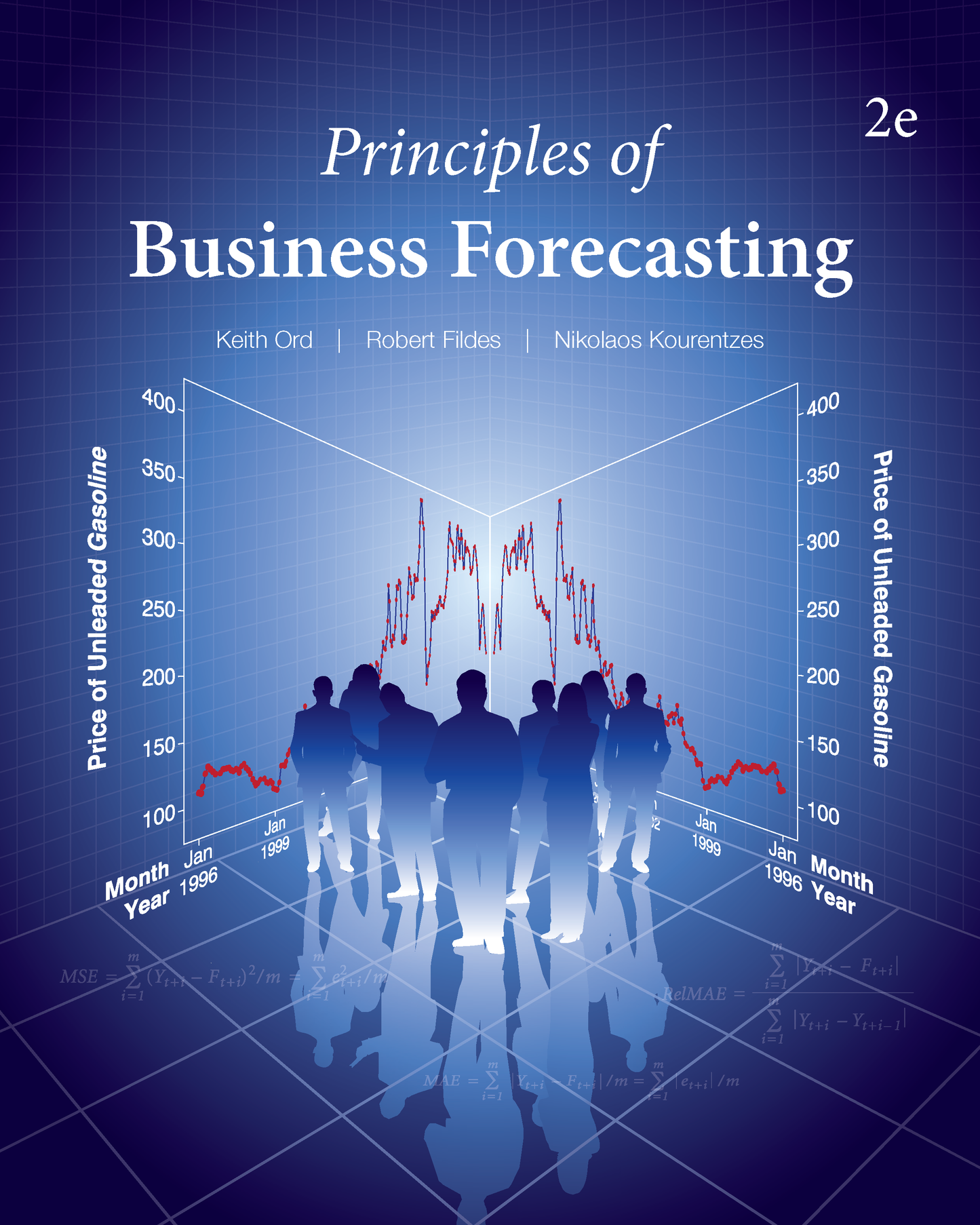
Description
This second edition of Principles of Business Forecasting by Keith Ord, Robert Fildes, and newest author Nikolaos Kourentzes serves as both a textbook for students and as a reference book for experienced forecasters in a variety of fields. The authors' motivation for writing this book is to give users the tools and insight to make the most effective forecasts, drawing on the latest research ideas without being overly technical.
Purchase options
This listing is for the complete textbook, which includes the full second edition of Principles of Business Forecasting. The content of the textbook can also be purchased separately in three individual parts. Each part is only available as an e-book. The parts are selected chapter collections and are not three sequential volumes of the complete book.
-
Complete textbook, 2nd edition
588 pages. Available in hardcover, softcover, and e-book formats. -
Part I: A First Course in Forecasting
E-book. 210 pages. Includes the Preface and Chapters 1, 2, 3, 4, 7, 8, and 12. Free download. -
Part II: Advanced Forecasting Methods
E-book. 190 pages. Includes the Preface and Chapters 1, 6, 9, and 10. $30.00. -
Part III: Forecasting Practice
E-book. 160 pages. Includes the Preface and Chapters 1, 11, 12, and 13. $30.00.
About the book
The book is unique in its design, providing an introduction to both standard and advanced forecasting methods, as well as a focus on general principles to guide and simplify forecasting practice for those with little or no professional experience. One of the book's key strengths is the emphasis on real data sets, which have been updated in this second edition. These data sets are taken from government and business sources and are used throughout in the chapter examples and exercises.
Forecasting techniques are demonstrated using a variety of software platforms beyond just R, and a companion website provides easy-to-use Excel macros that users can access to conduct analyses. Another important innovation in the second edition is the tutorial support for using open-source R programs, making all the methods available for use both in courses and practice.
After the introductory chapters, the focus shifts to using extrapolative methods, including exponential smoothing and ARIMA, then to statistical model-building using multiple regression. The authors also cover more novel techniques including data mining and judgmental methods, which are gaining increasing attention in applications.
The second edition also offers expanded material on data analytics, in particular neural nets together with software, and applications that include new research findings relevant and immediately applicable to operations, such as hierarchical modeling and temporal aggregation.
Finally, the authors examine organizational issues of implementation and the development of a forecasting support system within an organization, which is relevant to every manager, or future manager, who must make plans or decisions based on forecasts.
Please take a moment to review the companion website for additional content in the appendices, including Basic Statistical Concepts, an overview of Forecasting Software, and Forecasting in R: Tutorial and Examples, as well as the many data sets referenced in the chapters, macros such as the Exponential Smoothing and Trend Curve Macros and Time Series Neural Network Analysis, and student study materials.
Details
- ISBN (View all)
- 978-0-9990649-0-0
- Dimensions
- 8.0 x 10.0 in
- Length
- 588 pages
- Year Published
- 2017
Instructor Materials
This title includes access to course materials for verified instructors:- Choosing a selection results in a full page refresh.
- Opens in a new window.